7 Signs You Need a Clarifying Shampoo (Build-Up, Hard Water, Limp Hair)

Signs You Need a Clarifying Shampoo: 7 Real Checks

Quick Answer

Signs you need a clarifying shampoo include hair that feels coated or waxy right after washing, roots that go flat within hours, curls that lose their pattern, and products that seem to stop working. One clarifying wash followed by a deep condition works as a reset test: if your hair behaves normally again, buildup was the cause.

Signs you need a clarifying shampoo

Key Takeaways

Buildup is a film of residue layered over time, not one bad wash.

No single sign proves buildup, so match the sign to its cause before you act.

One clarifying wash plus a deep condition is the fairest test.

Scalp pain, thick scaling, or spreading redness need a doctor, not a stronger shampoo.

You wash your hair, rinse well, and an hour later it already feels coated. The roots sit flat, the lengths look dull, and the products that used to work now seem to sit on top of your hair instead of sinking in. It is easy to blame your shampoo, your water, or your hair itself, and to buy yet another bottle in search of a fix.

The honest answer is usually simpler, and it starts with knowing whether buildup is really the problem. When signs you need a clarifying shampoo appear, they point to a film of residue, not to dirty hair, and not to a hair type that cannot be helped. This guide walks through the seven signs, shows how to match each one to its cause, and gives you one simple test that settles the question before you change your routine. By the end, you will know whether to clarify, how often to do it, and when to leave your routine alone.

What Buildup Actually Is (and What It Is Not)

Buildup is a thin film that forms when residue is layered on the hair and scalp without being fully washed away. Silicones, waxes, oils, styling creams, and dry shampoo all leave something behind, and hard water minerals and chlorine can add to the layer. Over weeks, that film traps scalp oil at the roots, repels water so hair is slow to get wet, and scatters light so hair looks dull.

A clarifying shampoo works by using stronger cleansing agents that lift that film, as hair care sources describe, while a regular shampoo is built for gentle daily cleaning and often leaves conditioning agents behind. That difference is the whole point of clarifying, and it is also why it is a sometimes tool, not a daily one.

Buildup is not dirt, and it is not a sign of poor hygiene. It is also not damage. Damage roughens the hair surface and makes it tangle and break, while buildup coats a mostly healthy surface. The two can look similar at a glance, which is why matching the sign to the cause matters more than reaching for the strongest bottle first.

Layered residue film on hair surface

Signs You Need a Clarifying Shampoo: 7 Signs, Matched to Causes

Read the list slowly and mark only the signs you actually see. One sign on its own is a hint, not proof, and the pattern across the list is what points to buildup.

1. Hair feels coated or waxy right after washing. You rinse fully, yet the lengths still feel filmed, as if a thin layer stayed behind. This is the clearest residue sign, because a clean wash should leave hair feeling clean, not sealed. It often follows weeks of heavy oils, waxes, or leave-in products.

2. Roots go flat within hours. The roots look fine when wet, then fall flat and shiny soon after drying, even though you did not add more product. A film at the roots traps oil and weighs fine hair down, so volume disappears fast.

3. Hair is slow to get wet. Water beads or runs off instead of soaking in, and you need longer under the shower before the hair feels wet through. A residue film repels water, so slow wetting is a useful clue, especially when it is new.

4. Curls or waves lose their pattern. Curls fall limp, waves straighten out, and the shape you used to get after washing does not return. Weight from the film pulls the pattern down, and the hair springs back only once the film is gone.

5. Colour looks muddy or dull. Colour-treated hair turns flat and greyish, and shine fades even though the colour itself has not faded. The film scatters light before it reaches the hair, so the colour underneath looks worse than it is.

6. Products stopped working. Your usual conditioner, oil, or styling cream suddenly does nothing, or sits on the surface instead of sinking in. When the film blocks the hair, products cannot reach it, so changing products will not help until the film is removed.

7. Hard water or chlorine film. After swimming, or in a home with hard water, hair feels stiff, straw-like, and hard to comb, and it may look dull even right after washing. Minerals and chlorine add their own layer on top of product residue, and they need the same kind of reset.

If three or more of these match your hair, buildup is likely. If only one matches, read the next section before you act.

Signs That Look Like Buildup but Are Not

Dullness can also come from cuticle damage, where the hair surface is rough and scatters light, and no clarifying wash can repair that. Tangling can come from weathering and heat, not from a film. These need gentler care and time, not a stronger wash.

Plain oiliness is another common mix-up. If your roots turn greasy within a day but the lengths feel fine, the pattern may be plain oiliness rather than buildup. Our guide on why does my hair get greasy one day after washing explains how to tell the patterns apart before you change your wash.

Itching with flakes, redness, or soreness is a different matter again. That pattern can point to dandruff or another scalp condition, and a clarifying wash will not fix it. Compare the pattern with our guide on why does my scalp itch after oiling before you reach for a stronger wash, and get checked if the symptoms stay or spread. The next section gives you one simple test that settles the question.

The One-Wash Reset Test for Signs You Need a Clarifying Shampoo

Guessing wastes weeks, so run one controlled test instead. Change nothing else in your routine for this wash, so the result means something.

1. Wash once with a clarifying shampoo, massaging the scalp with your fingertips and letting the lather run down the lengths.

2. Rinse fully until the water runs clear and the roots no longer feel slippery.

3. Apply a deep conditioner from the mid-lengths to the ends, leave it for the time on its label, then rinse.

4. Dry and style exactly as usual, with no new products.

5. Judge the result the next day. If the coating is gone, the roots hold volume, and your products work again, it was buildup. If nothing changed, the cause sits elsewhere, and clarifying again will not help.

Do not repeat the test daily. One wash gives a clear answer, and repeating it only strips the scalp. Once you know it was buildup, the next question is how often to repeat it.

One wash reset test rinsing hair under water

How Often to Clarify, by Hair Type

There is no single schedule, because buildup forms at different speeds on different hair. Use these starting points, then adjust by what your hair tells you.

Fine or oily hair often needs clarifying every two to four weeks, because oil shows fast and light hair carries the film visibly. Wavy hair with a normal scalp often does well once a month, or whenever the signs return. Dry, curly, or colour-treated hair usually needs it less often, around every four to six weeks, because the lengths need the moisture that a strong wash removes.

Swimmers and people in hard-water homes may need it more often, but the rule stays the same: clarify only when the signs return, and always follow with a deep condition. If your hair feels stripped, rough, or straw-like after clarifying, you are doing it too often, and spacing it out further is the fix. The Safety Box below covers the signs that need a doctor instead of another wash.

Different hair types need different clarifying frequency

Safety Box

Stop and get checked if you notice sores, swelling, spreading redness, thick crusts, sudden patchy hair loss, or itching that does not settle after you simplify your routine. These signs need a doctor or dermatologist, not a stronger shampoo. This guide gives general information only and does not diagnose any condition.

People Also Ask

How do I know if I have product buildup in my hair?

Hair that feels coated or waxy right after washing, roots that go flat within hours, and products that stop working are the usual clues. The fairest check is one clarifying wash plus a deep condition: if the hair behaves normally again, buildup was the cause.

Can clarifying shampoo damage your hair?

It can dry the hair and roughen the surface if used too often, because it strips oils along with residue. Used occasionally and followed by a deep conditioner, it is a reset tool, not a daily wash. Colour-treated or dry hair needs it least often.

How often should you use a clarifying shampoo?

Fine or oily hair often needs it every two to four weeks, normal hair about once a month, and dry, curly, or colour-treated hair every four to six weeks, according to hair care guidance. The signs, not a calendar, should decide the timing.

Does hard water cause buildup in hair?

Yes, minerals in hard water can leave a film on the hair that makes it feel stiff, dull, and hard to comb, and the same film can form after swimming in chlorinated water. A clarifying wash plus a deep condition removes that layer.

Is dry shampoo buildup bad for your scalp?

Dry shampoo absorbs oil for a day but washes nothing away, so daily use layers powder on the scalp and roots. That layer can make hair look coated and dull, and it can hide the real pattern underneath. Use it between washes only, and wash fully on wash day.

Conclusion

Signs you need a clarifying shampoo are useful only when you match them to a cause, and the one-wash reset test is the fairest way to confirm it. If your hair resets, buildup was the problem, and a calm rhythm of occasional clarifying plus deep conditioning will keep it from coming back. If it does not reset, look at damage, oiliness, or your scalp instead of washing harder. Start with one clarifying wash this week, and let the result guide your next step.

Sources

HairTrait, signs of buildup and wash rhythm; The Hair Society, on no single sign proving buildup; HairCareBrief, buildup as layers; GK Hair, surfactant and chelating action; American Academy of Dermatology; Cleveland Clinic; Mayo Clinic.

This article is for general information only and is not medical advice.

Paula’s Choice Skin Perfecting 2% BHA Liquid Exfoliant Review: How to Use It Only Where You Actually Clog

Paula's Choice Skin Perfecting 2% BHA Liquid Exfoliant Review:

Fact-checked: 23 November 2026 — claims checked against published studies and product labels. Reviewed by the Health Rise editorial team.

How we review: We check the product label, published studies and real buyer reviews, and we list the pros and cons plainly. We do not claim hands-on testing we have not done. Read how we research: How We Research

1. The Hook

You treat your whole face the same way, every night. You smooth the same product over clear cheeks, a calm forehead, and a nose that always clogs first. Then you wonder why the clear areas feel tight, while the clogged zones barely change. The problem is not effort. The problem is coverage. You do not have one skin problem. You have zones, and zones need different care. What if you treated only the zones that clog, and left the rest alone? That single change changes the whole routine, and it starts with a question you have probably asked in the mirror: why does the same face need the same treatment everywhere?

Paula

See Price and Reviews

2. The Problem, Felt

You know the pattern. Your forehead breaks out in small, stubborn bumps, while your cheeks stay clear. Your nose feels rough, no matter how often you wash it. You try a scrub, and the surface feels smooth for a day, then the same clogs return. You add another active, and the clear areas turn red first. You start to think your skin is difficult, when the routine is the difficult part. If your bumps sit only on your forehead, the pattern behind them matters first, and that pattern is explained in why forehead-only bumps follow a pattern. The pattern tells you where to treat, and where to leave alone. Once you see the zones clearly, the next question is simple: what kind of step can reach inside a clog, instead of just smoothing over it?

Forehead and nose zones showing where clogged pores form

3. The Reveal

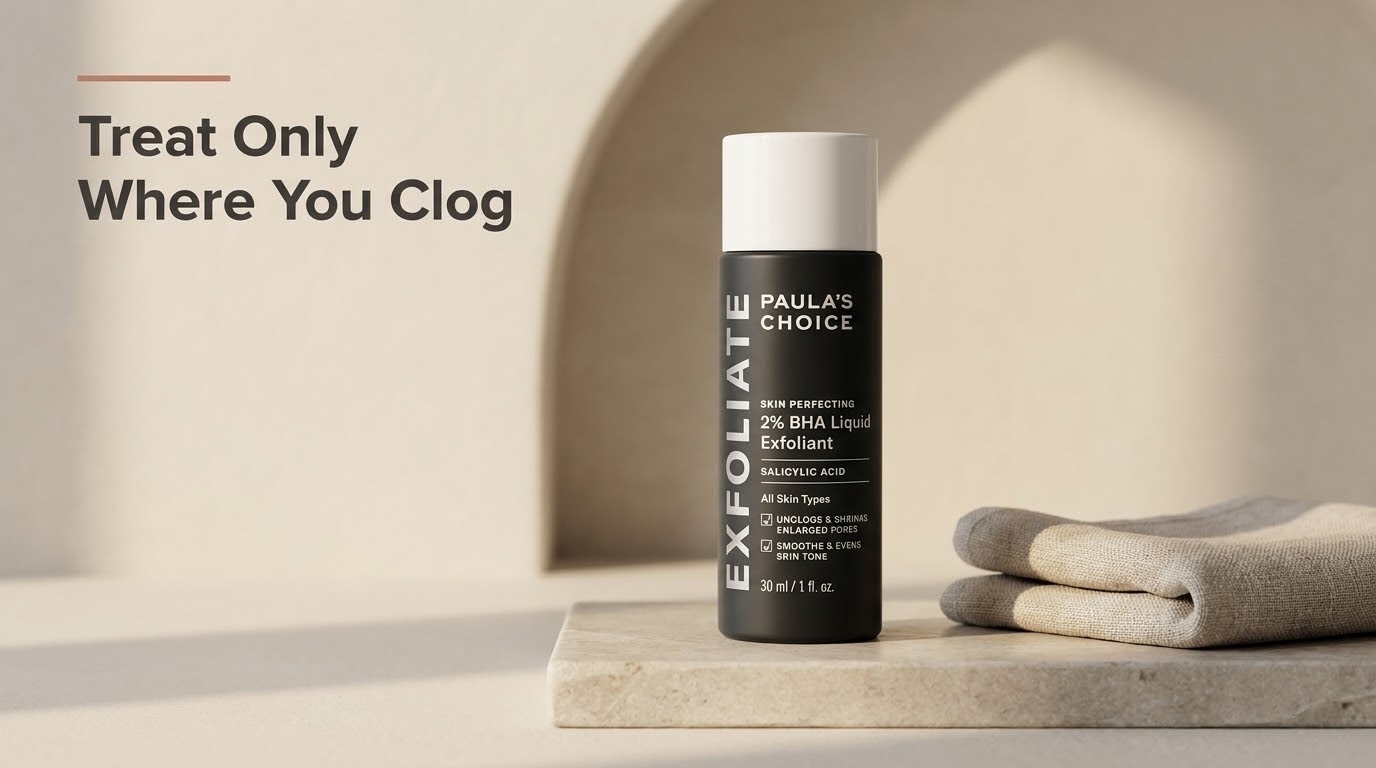
That step is Paula’s Choice Skin Perfecting 2% BHA Liquid Exfoliant. It is a leave-on liquid, not a rinse-off product, and not a toner, even though its texture feels toner-like. The brand explains that 2% salicylic acid, an oil-soluble ingredient, can work inside oil-filled pores, where surface products cannot reach. The formula also includes green tea, and it is fragrance free and alcohol free. You apply it after cleansing and toning, then you follow with serums, moisturiser, and daytime sun protection. You do not rinse it off. The photos below show the bottle up close, and tapping one lets you check the current details with your own eyes.

4. Paula’s Choice Skin Perfecting 2% BHA Liquid Exfoliant Review: What Sets It Apart

Inside the Pore, Not on the Surface

A scrub works on the surface. This liquid works differently, because salicylic acid is oil-soluble. The brand explains that it can enter oil-filled pores and help clear the material that keeps a pore clogged. For a forehead band or a rough nose, that difference matters more than a smoother surface for a day.

One Thin Layer, No Scrub Damage

You use a pea-sized amount, applied with clean hands, not a saturated pad. The liquid is lightweight, and it layers under moisturiser without a heavy film. That thin layer is the whole step, and it replaces the scrub in a routine that already feels crowded.

Thin liquid exfoliant applied with clean hands on the forehead zone

A Ramp You Can Actually Follow

The brand explains that you start every other day, or two to three nights a week, and you increase only if skin stays calm. You reduce frequency if dryness appears. That ramp is the reason a strong-sounding percentage can still fit sensitive-leaning skin, when you treat only the zones that need it.

Texture That Layers, Not Fights

Buyers describe a thin, watery liquid that dries with a brief sheen, and a faint scent that fades. You let it dry for a few minutes before moisturiser. That pause keeps the layer from pilling under the next step, and it keeps the routine simple.

Pros: oil-soluble 2% salicylic acid; leave-on, no rinse; lightweight and layers under moisturiser; fragrance free and alcohol free; zoned use possible.

Cons: purging in the first weeks; brief tack or sheen; daily sun protection required; not for a broken barrier; needs weeks, not overnight.

If you want to see the current details, check them for yourself before you decide.

5. What Buyers Are Saying

Buyers describe the same pattern again and again, smoother texture, clearer pores, and a routine that stays simple.

Veronica Wadsworth: “I noticed an immediate difference, especially on the skin on my neck.”

Devon Adelman: “I have been figuring out how to clear out the gunk in my pores forever”

The Princes: “It contains 2% salicylic acid, which helps unclog pores and improve the appearance of blackheads and blemishes.”

Waldy: “I really like the lightweight formula of this exfoliant.”

Isa Morales: “Nothing, has ever made my skin so pretty and clear and so fast like this product.”

Taylor Jenkinson: “My skin just looks more even and feels so much smoother when I use it consistently.”

Melanie Cullen: “It makes my skin feel clean, smooth even hydrated before I go in with moisturizer after using this.”

Matty Cherie and Big Sugaree: “Make sure that you let it dry for 10 minutes before applying your moisturizer.”

Isabella Brown: “I use it ONLY on my problem areas, and I let it dry for a few minutes before applying moisturizer.”

Unique: “I use it for two days and I really noticed a difference on my skin”

Hands applying a thin liquid on the forehead zone, buyer atmosphere

One more photo waits below, and tapping it shows the same details, straight from the product page, with no extra claim here.

6. Paula’s Choice Skin Perfecting 2% BHA Liquid Exfoliant Review: Is This Made for You?

Built for people who clog in zones, on the forehead, nose, or chin, while other areas stay clear. Built for people who want one leave-on step, not a shelf of scrubs. Built for people who can start slowly, two nights a week, and stay consistent for weeks.

Not for people whose barrier is currently broken, burning, or over-exfoliated. Not for people who want an overnight change, or who skip sun protection in daytime. Not for people whose routine already controls congestion with another strong active, and who do not need a second one.

The closing photo is next, and tapping it takes you to the same product page to check everything yourself.

People Also Ask About Paula’s Choice Skin Perfecting 2% BHA Liquid Exfoliant Review

Does Paula’s Choice 2% BHA cause purging?

Yes, it can. The brand explains that BHA speeds turnover and brings trapped clogs to the surface, usually over two to four weeks in areas you already clog. Small bumps in familiar areas, without burning or swelling, fit that pattern. Burning, swelling, or new areas do not, and those need a pause and a clinician’s advice.

How often should you use it at first?

Start every other day, or two to three nights a week, and increase only if skin stays calm, toward once or twice daily at most. Reduce frequency if dryness appears, moisturise after, and use sun protection with a factor of 30 or higher in daytime.

Is it a toner, and do you rinse it off?

No to both. It has a toner-like texture, but it is a leave-on exfoliant. You apply it after cleansing and toning, you do not rinse, and you follow with serums, moisturiser, and daytime sun protection.

Can it help closed comedones on the forehead?

It fits the mechanism, because oil-soluble salicylic acid works inside the pore on the plug that forms a closed comedone. Removing the input first also matters, hair-product residue off the hairline, clean headwear, and a washed forehead after hair care.

7. The Close

That is the point of this paula’s choice skin perfecting 2% bha liquid exfoliant review. You do not need to treat your whole face to fix the zones that clog. You need one thin, leave-on step, used only where you clog, started slowly, and judged over weeks, not days. The forehead band, the rough nose, and the stubborn chin bumps all point to the same question: what happens inside the pore, not on the surface?

Calm morning routine with the exfoliant bottle beside moisturiser

Tap the button below to check the current details with your own eyes.

See Price and Reviews

Affiliate links: I may earn a commission at no cost to you.

Why Do I Get Closed Comedones Only on My Forehead? The Hair-Product Connection

Man checkig why do i get closed comedones only on my forehead in a mirror

Quick Answer

If you keep asking why do i get closed comedones only on my forehead, check where the bumps sit. A band along the hairline points to hair products, a band where a hat or headband sits points to friction and sweat, and bumps across the T-zone point to oil and shedding. The pattern names the cause.

Man checking why do i get closed comedones only on my forehead in a mirror

For an exfoliant that unclogs pores, read the Paula’s Choice 2% BHA Liquid Exfoliant review.

Key Takeaways

The bump pattern is the diagnosis: hairline band, hat-line band, or all-over T-zone.

Hair products are the most overlooked forehead cause, and the most fixable one.

Remove the input first, then add one treatment, and give it weeks, not days.

Squeezing a closed comedone has no exit to open, so it usually leaves a mark instead of clearing the bump.

Bumps that appear only on the forehead are frustrating because the rest of the face stays clear, which makes the advice feel useless. If you keep asking why do i get closed comedones only on my forehead, the answer is rarely one cause. The forehead is different from the rest of the face in two ways that matter. First, it carries one of the highest densities of oil glands on the body, so it produces more oil than the cheeks. Second, it sits under the hairline, which means everything put on the hair, and everything worn on the head, ends up on this skin. That combination explains why the same person can have a clear chin and jawline while the forehead stays bumpy for months. This article uses the bump pattern as the check: where the bumps cluster points to what is clogging the pores, and that answer decides what to change first.

What a Closed Comedone Actually Is

A closed comedone is a pore plugged with oil and dead skin cells under a thin layer of surface skin. Because the plug never opens to the air, it never oxidizes, so it stays flesh-colored instead of turning dark like a blackhead. Most are small, firm, and flat, and they do not contain pus, which is why they cannot be popped. The plug itself forms when skin cells at the pore opening stick together instead of shedding, and sebum keeps building behind that plug. This is also why these bumps are stubborn. Ordinary spot treatments sit on top of the plug and never reach the material inside. Clearing them needs either an oil-soluble active that works inside the pore, or an active that normalizes shedding so new plugs stop forming. Both routes take weeks, because skin turns over slowly and every existing plug must work its way out.

Why Do I Get Closed Comedones Only on My Forehead? Start With Where the Bumps Sit

Stand in front of a mirror and map the bumps before changing any product. Four patterns cover almost every forehead-only case. First, a band that follows the hairline, temples, and upper forehead, and stops where the hair stops. Second, a band that follows the exact line of a hat, headband, helmet, or fringe. Third, bumps spread evenly across the whole forehead, including the middle, with no clear edge. Fourth, bumps that are uniform, tiny, and itchy, and appeared suddenly, sometimes with similar bumps on the chest or back. The first pattern points to hair products. The second points to friction and trapped sweat. The third points to oil and shedding across the T-zone. The fourth is a lookalike that needs a different approach, covered below. Naming the pattern first saves months of trying the wrong fix.

The Hair-Product Connection: How Pomade Acne Forms

Pomade acne is the informal name for closed comedones caused by hair products, and it is a form of acne cosmetica, where the product itself is the trigger. Heavy ingredients such as petrolatum, lanolin, mineral oil, waxes, and coconut oil physically block follicles. Silicones such as dimethicone and amodimethicone add a film over the skin that traps sebum and dead skin underneath. These ingredients reach the forehead in ordinary ways: sweat carries them down during the day, pillows press product-laden hair against the skin at night, and rinsing hair in the shower washes residue straight over the forehead. Fringes and side sleeping make it worse. People miss this cause because they never connect the hair routine with the skin, and the bumps look like ordinary acne. The fix is practical. Switch to lighter, water-based, non-comedogenic hair products. Apply styling products at least an inch away from the hairline, on the mid-lengths and ends rather than the roots. Rinse conditioner thoroughly, wash the forehead after hair care, change pillowcases more often, and avoid sleeping with product still in the hair. Dermatology guidance reports bumps tending to clear within four to six weeks after the product is stopped.

Hand holding hair styling product near the hairline on a stone ledge

Why Do I Get Closed Comedones Only on My Forehead? When the Cause Is Not Hair Products

If the bumps do not follow the hairline, check the next two patterns. Acne mechanica comes from pressure, friction, and trapped heat: hats, helmets, and headbands that press against the forehead during work or sport, especially with sweat. Loosening the fit and cleaning the inside band weekly usually helps. The all-over T-zone pattern comes from oil and shedding. The forehead carries an unusually dense concentration of oil glands, and hormonal shifts during puberty, menstrual cycles, or stress can push those glands harder. High-glycemic foods and dairy are linked in some studies to higher oil production, though the effect is modest next to products and friction. Heavy products applied forehead-wide also count: a rich moisturizer chosen for dry cheeks, or an occlusive sunscreen, can clog a forehead that needed far less. Two lookalikes matter. Malassezia folliculitis, often called fungal acne, brings uniform, itchy, tiny bumps, usually without comedones, and it needs antifungal care rather than acne products. Milia are hard, white, pinhead cysts that sit deeper and do not respond to exfoliation the same way. If the bumps are itchy, uniform, and sudden, that distinction is worth a clinician’s opinion.

A Calmer Forehead Routine That Clears Bumps Without Stripping Skin

Start by removing the input, not by adding a treatment. Give the product change two full weeks: lighter hair products kept off the hairline, headwear cleaned, and nothing heavy applied forehead-wide. Then add one treatment, not three. A 2 percent salicylic acid product used a few nights a week is the gentler starting point, because salicylic acid is oil-soluble and works inside the oily pore to dissolve the plug. Adapalene is stronger for stubborn or widespread bumps because it normalizes shedding across the skin, but it irritates more at first. Whichever one is chosen, introduce it slowly, moisturize lightly, and change nothing else in that window. Timelines matter. Pomade-type bumps often fade within four to six weeks after the product is stopped, while closed comedones generally need six to twelve weeks of consistent care. Three mistakes undo progress: squeezing, which has no exit to open and leaves marks; stacking several exfoliants at once, which creates irritation that looks like more bumps; and harsh stripping, which provokes the glands into producing even more oil.

Man applying a light gel to his forehead, seen from behind
Man washing his face at a stone sink in soft window light

Safety Box

Get checked promptly if bumps become deep, painful lumps, if redness or swelling spreads, or if scarring or dark marks start forming. Sudden, itchy, uniform bumps, especially with chest or back involvement, also deserve a clinician’s look, since they may not be acne at all. If a steady routine shows no change after twelve weeks, the cause may be something the routine cannot reach. Bring a list of hair and skin products used, since that list often answers the question faster than any single test.

The pattern gives you a place to start. Change one input, keep the rest of the routine steady, and give the change enough weeks to show. The questions below cover what readers usually ask once they start.

Questions Readers Ask About Forehead-Only Bumps

Can shampoo and conditioner really cause forehead bumps?

Yes. Oils, waxes and silicones from shampoo, conditioner and styling products migrate onto the forehead through sweat, pillows and hair washing. They form a film that traps sebum and dead skin inside pores, which shows up as small flesh-colored bumps along the hairline. Keeping products away from the hairline and washing the forehead after hair care breaks the cycle.

How long does it take for forehead bumps to clear after stopping a hair product?

After stopping the product that clogs pores, pomade-type bumps often fade within four to six weeks, according to dermatology guidance. Closed comedones in general take longer, around six to twelve weeks, because each plug must work its way out as skin turns over. If nothing changes after twelve consistent weeks, the cause may be something else.

Is salicylic acid or adapalene better for closed comedones?

Salicylic acid is the gentler starting point because it is oil-soluble and works inside the oily pore to dissolve the plug. Adapalene is stronger for stubborn or widespread bumps because it normalizes shedding across the skin, but it irritates more at first. Start with one, not both, and add the second only if the first proves too weak.

How do I tell fungal acne from closed comedones?

Fungal acne, properly called Malassezia folliculitis, looks different: the bumps are uniform, tiny, often itchy, and appear suddenly, sometimes with chest or back bumps too. Closed comedones are flesh-colored, firm, non-itchy and persist for weeks. The two need different treatment, so sudden itchy uniform bumps are worth showing a clinician.

Should I squeeze or extract closed comedones?

No. A closed comedone has no open exit, so squeezing mostly injures the surrounding skin and can turn a flat bump into an inflamed spot or a lasting mark. It also risks pushing the plug deeper. Leave the bump alone and let a gentle exfoliant or retinoid clear it over weeks instead.

Conclusion

Forehead-only bumps feel random until the pattern is checked. A hairline band points to hair products, a hat-line band points to friction and sweat, and bumps across the whole T-zone point to oil and shedding. If you keep asking why do i get closed comedones only on my forehead, let the pattern answer first, then change one input and give it weeks. Remove the product, keep the routine calm, add one treatment, and resist squeezing. Most forehead patterns improve once the real input is gone, and the ones that do not are the ones worth showing a clinician.

Sources

Verywell Health, Causes of Forehead Acne and What to Do About It; Linia Skin Clinic, Forehead Acne: Causes and Treatments; Skin Concern Lab, Closed comedones on the forehead: causes and a patient fix; OnlyMyHealth, Pomade Acne: Expert Shares Causes, Risks and Tips To Treat; CosmeSurge, Closed Comedones on Face: Forehead, Chin, Cheeks and Jawline.

This article is for general information only and is not medical advice.
OLLY Sleep Gummies (Melatonin + L-Theanine) Review

OLLY Sleep Gummies (Melatonin + L-Theanine) Review

Fact-checked: 22 November 2026 — claims checked against published studies and product labels. Reviewed by the Health Rise editorial team.

How we review: We check the product label, published studies and real buyer reviews, and we list the pros and cons plainly. We do not claim hands-on testing we have not done. Read how we research: How We Research

Wondering how fast melatonin works? Read how long melatonin takes to kick in.

1. The Hook

You are tired. Your body is ready, but your mind is still running the day on repeat, and every minute awake makes the morning feel closer. This OLLY Sleep Gummies (Melatonin + L-Theanine) Review looks at a bedtime gummy built for exactly that moment: a racing mind, not a broken body. It is tasty, it is popular, and it raises one dose question that most reviews skip entirely. If your nights look like that, the next few minutes will either save you a purchase or make you confident about one. What is the dose question, and does this gummy answer it?

OLLY Sleep Gummies (Melatonin + L-Theanine) Review: purple bottle beside a glass of water at night

See Price and Reviews

2. The Problem, Felt

You know the pattern. You get into bed on time, you put the phone down, and then your brain starts replaying conversations, deadlines, and worries you thought you had finished with. You count the hours left until the alarm, which only makes sleep harder to find. You have tried plain melatonin before, or you have avoided pills entirely because swallowing them feels like a chore at midnight. You want something that calms the noise without knocking you out, and you want to wake up clear instead of groggy. The question underneath all of it is simple: what actually helps a racing mind let go?

Adult man lying awake in bed at night, OLLY Sleep bottle and 2 AM clock on the nightstand

3. The Reveal

The product is OLLY Sleep, a gummy supplement in Blackberry Zen flavor. Each bottle holds 50 gummies, and the front label states 3 mg of melatonin per 2 gummies, paired with L-theanine and botanicals. The brand describes it as a bedtime companion that helps you mellow your mind, calm your senses, and relax into sleep, and it positions the gummies as occasional support for nights when sleep is harder to find. The gummies are gluten free, with no synthetic colors and no synthetic flavors, and the directions say adults take 2 gummies 30 minutes before bed, chewed thoroughly. That is the whole pitch in one paragraph, and it sounds simple. The interesting part is what the label does not shout about.

Tap any photo in this article to see the current price, rating and reviews for yourself.

4. What Sets It Apart: OLLY Sleep Gummies (Melatonin + L-Theanine) Review

A Modest Dose in a Market That Shouts Louder

Most sleep gummies on the shelf push 5 mg or 10 mg of melatonin, as if a bigger number must mean better sleep. This one states 3 mg per 2 gummies, which is 1.5 mg per single gummy, and the brand itself advises new users to start with a lower melatonin dosage. Think of melatonin as a dimmer signal for your body clock, not a knockout switch: the point is to nudge the wind-down, not to force it. For a first-time buyer, that middle path is the honest starting point.

L-Theanine, the Calm Before the Sleep

Melatonin is only half the blend. The brand says L-theanine promotes relaxation and stress reduction, helping the mind unwind, and that it helps increase alpha brain waves to calm and relax your mind. That is the ingredient aimed at the racing mind from Section 1: melatonin signals the clock, while L-theanine is meant to quiet the noise around it. The Supplement Facts panel states the L-theanine amount: 50 mg per 2-gummy serving. (The June 2024 NIH Dietary Supplement Label Database label states 100 mg — the amount has varied by label version, but it is stated on the label in both cases.)

OLLY Sleep bottle with blackberry gummies on a bedside table

Botanicals and a Flavor You Will Not Dread

The blend has three botanicals: chamomile flower extract 17 mg, passionflower aerial parts extract 17 mg, and lemon balm aerial parts extract 16 mg per 2-gummy serving. The flavor is Blackberry Zen with other natural flavors, plus a hint of mint, and buyers return to taste again and again in their own words. A sleep aid only works if you take it, and a soft, tasty gummy removes the nightly friction that makes people skip pills.

A Ritual, Not Another Pill

The directions are simple: adults take 2 gummies 30 minutes before bed, chewed thoroughly. The brand’s own sleep hygiene panel pairs that step with the same calming actions each night, a consistent bedtime, and low light with less screen time. For readers who dislike swallowing pills, a chewable turns the dose into a ritual instead of a chore, and rituals are easier to keep than rules.

If a modest dose with a calming partner sounds like your kind of middle path, see the OLLY Sleep gummies here and check the current details for yourself.

5. What Buyers Are Saying

Buyers talk about taste and texture first, and about falling asleep second. Here is what they actually wrote, in their own words:

Carol Smith: “But they do help me sleep better and wear off in about four hours.”

Kindle Customer: “I typically sleep 8 hours a night now with no trouble falling asleep.”

Alex: “I let them melt in my mouth and in less than 20 minutes I’m out!”

Cedar’s birthday: “For my husband these legit knock him OUT.”

Tess: “But otherwise the gummies are soft, easy to chew and dose, and effective.”

GirlFriday: “I like the product. Taste good. They do the job.”

DD: “Nice quality and consistency, I buy it monthly and have never had an issue with quality or consistency.”

ashleyannsmith: “These actually work wonderfully for me!”

Katie Trefftzs: “Tastes great and helps sleep.”

Elias Perez: “They work! Very pleased and will buy more.”

Hand holding the OLLY Sleep bottle near a bedside lamp

The pattern is consistent: taste and texture win praise, sleep onset gets the credit, and the complaints cluster around heat, late timing, and person-to-person differences. That mix is exactly why the next section separates the promise from the fine print.

The photos here show the bottle up close, so tap one to check the current price, rating and reviews before you decide.

Pros and Cons

Pros: modest 3 mg melatonin dose per serving; L-theanine plus chamomile flower extract 17 mg, passionflower aerial parts extract 17 mg, and lemon balm aerial parts extract 16 mg per 2-gummy serving; Blackberry Zen taste buyers praise; soft, easy chew with no pills to swallow; gluten free with no synthetic colors or flavors; clear 30-minute directions; no stevia or sucralose noted by buyers comparing brands.

Cons: gummies can melt or stick together in heat and summer shipping; contains gelatin, so it is not vegan or vegetarian; sweetened with glucose syrup and beet sugar; the Supplement Facts panel states the L-theanine amount: 50 mg per 2-gummy serving; morning grogginess reported when taken too late; results vary person to person; for occasional sleeplessness only, not a treatment for ongoing sleep problems.

6. Is This Made for You?

This gummy is built for people who: struggle with occasional sleeplessness and a racing mind at night; dislike swallowing pills and want a tasty chewable; want a modest 3 mg starting point rather than a high dose; and like the idea of a steady wind-down ritual.

It is not for: children, since the label says to keep it out of reach of children; vegans and vegetarians, since the gummies contain gelatin; anyone who needs treatment for ongoing sleep problems, since the label states it is not intended for that and a clinician conversation is the right step; and anyone taking medicines that can interact with melatonin, who should talk with a healthcare professional first, as Mayo Clinic advises.

If you see yourself in the first list, tap any photo in this article to see the current price, rating and reviews with your own eyes.

People Also Ask About olly sleep gummies (melatonin + l-theanine) review

Do OLLY melatonin gummies actually work?

The brand says 3 mg of melatonin per serving helps support falling asleep and a healthy sleep cycle. Independent guidance says melatonin evidence is strongest for circadian problems and modest for general sleep onset, so expect support for falling asleep, not a cure for poor sleep.

How much melatonin is in 1 Olly sleep gummy?

Each gummy contains 1.5 mg of melatonin, and the serving is 2 gummies, which makes 3 mg in total. That is exactly what the front label states: 3 mg of melatonin per 2 gummies.

Are OLLY sleep gummies safe, and what are the side effects?

Mayo Clinic lists the most common melatonin effects as headache, dizziness, nausea, and daytime drowsiness, with vivid dreams or nightmares less common. Do not drive within five hours of taking it, and check with a healthcare professional about interactions with your medicines.

Can I take OLLY Sleep every night?

The brand positions it as occasional support on nights when sleep is harder to find, and the label says it is for occasional sleeplessness. If sleep problems last for weeks, talk with a clinician instead of raising the dose on your own.

7. The Close

This OLLY Sleep Gummies (Melatonin + L-Theanine) Review comes back to the question it started with: a racing mind does not need a stronger hammer, it needs a calmer signal at the right hour. A modest 3 mg serving, L-theanine for calm, botanicals for tradition, and a taste you will not dread make this gummy easy to keep as a ritual. The one question left is what the product page shows right now, and only you can answer that by looking.

Calm bedroom at night with a book, lamp, and sleep gummies bottle

Tap the button below and check the price, rating and reviews with your own eyes.

See Price and Reviews

Affiliate links: I may earn a commission at no cost to you.

How Long Does Melatonin Take to Kick In? The Honest Answer by Form, Not One Number

How long does melatonin take to kick in, by form, shown as a calm bedside scene at night

Quick Answer

How long does melatonin take to kick in? Most immediate-release forms, including gummies, are felt in 30 to 60 minutes, with peak levels around 1 to 2 hours. Extended-release forms take about 1 to 2 hours. Food, light, and a late dose can all push the effect later.

How long does melatonin take to kick in, by form, shown as a calm bedside scene at night

Key Takeaways

Form decides the range: immediate-release forms and gummies are usually felt in 30 to 60 minutes, while extended-release forms take about 1 to 2 hours.

Food, bright light, and a late dose can all push the effect later.

Taking it too late is the most common reason it seems not to work.

Do not take a second dose in the same night just because the first one feels slow.

Melatonin mainly helps with falling asleep, not with staying asleep all night.

You know the scene. You lie awake, watch the minutes pass, and wonder whether the melatonin you took an hour ago is ever going to work. The question behind that moment is simple: how long does melatonin take to kick in, and did you take it at the wrong time? This guide answers that question honestly, form by form, because the clock changes with the form you take. You will learn the realistic range for each form, the food and light factors that push it later, and the timing mistake that makes most people declare melatonin useless. You will also learn what melatonin cannot do, so you stop expecting a sleeping pill result from a sleep signal. By the end, you will know exactly when to take it, what to change first when it feels slow, and when the pattern needs a clinician instead of a stronger gummy. The honest answer starts with one idea: there is no single minute, only a range, and the range has a reason.

How Long Does Melatonin Take to Kick In, by Form

Most guides give one number and stop there. That is why readers get confused: one site says 20 minutes, another says 2 hours, and both sound sure. Both can be right, because they are describing different forms.

Immediate-release tablets are usually felt in 30 to 60 minutes, with peak levels around 1 to 2 hours. Gummies sit in the same range, and Sleep Foundation notes there is no data showing gummies work faster or slower than tablets, so do not pay extra for speed that has not been shown. Liquid or dissolving forms are reported fastest in pharmacist summaries, with peak levels in about 15 to 50 minutes for dissolving forms. Extended-release or slow-release forms are felt in about 1 to 2 hours, with the effect stretched over several hours rather than one clear peak.

One famous number needs a warning. The NHS page that says melatonin takes around 1 to 2 hours to work describes the UK slow-release prescription context, with 2 mg slow-release tablets taken before bed. It is not a universal number for every over-the-counter product in the United States. When you see one number quoted as the answer, check which form it was describing first.

Your body also makes its own melatonin. It starts to rise about 2 hours before your habitual bedtime, peaks in the early hours of the morning, and falls during daylight. A supplement works with that rhythm, not instead of it.

Why the Answer to How Long Does Melatonin Take to Kick In Moves

Food matters, but not in one simple rule. A high-fat meal can push the effect later by 30 minutes or more, and prescribing information for one slow-release product notes that food can delay its peak concentration by over 2 hours. At the same time, the NHS notes that slow-release tablets are best taken with food, while standard tablets are taken 2 hours before or after food. Form matters here too, so do not apply one food rule to every form. If you took your dose right after a heavy, fatty dinner, a later effect is normal, not a sign of a bad product.

Evening meal and glowing phone on a wooden table at dusk

Light matters as well. Bright light and screens in the evening can delay your body’s own natural melatonin rise. Taking a supplement and then staring at a bright screen for an hour works against the very signal you just took.

Timing against your own rhythm matters. Taking melatonin long after your body has already started its wind-down is different from taking it as that wind-down begins. The same dose can feel useless at midnight and helpful at 10 p.m., because the clock changed, not the capsule.

Dose matters, but not the way people expect. A higher dose does not reliably mean a faster or stronger effect. Several sources note that more is not faster, and it can mean next-morning grogginess instead. Summaries often mention low doses as commonly effective for many people, but this article does not prescribe a dose. Follow the label on the product you actually use.

Finally, people differ. Metabolism, age, and sensitivity all shift the range a little. That is why honest guides give ranges, and why a friend’s exact minute is not a promise for you.

The Timing Mistake: Taking It Too Late

Here is the scene that repeats every night in thousands of bedrooms. It is past midnight. You cannot sleep. You take melatonin and expect to drift off in 20 minutes. Forty minutes later you are still awake, so you decide melatonin does not work for you.

Hand holding a phone in bed late at night, clock showing past midnight

In most of those nights, melatonin did not fail. The timing failed. An immediate-release dose needs about 30 to 60 minutes to be felt, and it needs a dark, calm wind-down around it. Taken at midnight, with a bright phone in hand and a mind still running, it is fighting uphill. Worse, if it finally kicks in near morning, you may wake up groggy and blame the product a second time.

The other version of the mistake is taking it far too early and then staying in bright light for hours. The signal gets sent, then ignored, and by bedtime its effect has already faded. Both mistakes have the same root: treating melatonin like a switch that works the moment you swallow it, instead of a signal that needs the right hour and the right darkness.

If you remember one line from this article, make it this one: most melatonin failures are timing failures, not product failures.

A Calm Timing Routine

A routine that works is boring on purpose. Pick one time each night, relative to your bedtime, and keep it steady instead of changing it nightly.

Calm bedtime routine, book and warm lamp beside a bed at night

First, aim to take it about 1 to 2 hours before bedtime, which is the general practice most sources describe. Then dim the lights. Put the phone down, or at least turn its brightness down and stop scrolling. Keep the bedroom dark and cool. Do the same thing tomorrow night, at the same time, even if tonight felt slow.

Second, stop clock-watching. Checking the time every ten minutes turns waiting into anxiety, and anxiety is the enemy of sleep. Take the dose, start the wind-down, and let the range do its work. Judge the routine over several nights, not one night, because one restless night can have ten causes that have nothing to do with melatonin.

Third, keep the rest of the night steady. A heavy, fatty meal right before the dose, a bright screen marathon, or a sudden change of bedtime can all undo a good routine. Consistency beats perfection: the same time, the same dim light, the same calm wind-down.

Timing questions come up with other supplements too. For one supplement where meals matter more than the clock, see vitamin D in the morning or at night.

If It Does Not Seem to Work

Before you declare melatonin useless, run a short checklist. Which form did you take? Did a heavy meal sit right before the dose? Was the room bright, with screens on, until bedtime? Did you take it far later than usual? Has this happened for one night, or for many nights in a row? One bad night proves very little. A pattern over many nights, with steady timing and dim light, tells you much more.

Do not take a second dose in the same night because the first one feels slow. A second dose does not speed up the first one, and it raises the chance of morning grogginess. If the dose has not worked, the safe move is to wait until the next night and fix the timing, or check the label and ask a clinician, not to stack doses in the dark.

Be honest about what melatonin can and cannot do. The American Academy of Sleep Medicine, in secondary summaries of its guidance, supports melatonin for circadian problems such as jet lag and delayed sleep phase, but does not recommend it as a treatment for chronic sleep-onset or sleep-maintenance insomnia. In that guideline context, the average reduction in time to fall asleep was only about 9 minutes compared with placebo. That is a modest effect, not a cure. If sleep problems have lasted for weeks, melatonin alone is probably not the answer, and the Safety Box below matters more than any timing trick.

Melatonin and Staying Asleep

Melatonin leaves the body fairly fast. Its half-life is about 40 to 60 minutes, which means most of an immediate-release dose is cleared in about 4 to 5 hours. That is why it mainly helps with falling asleep, not with staying asleep until morning. If you fall asleep fine but keep waking in the middle of the night, the problem is usually a different pattern from slow sleep onset.

For that pattern, see why do i wake up at 3am every night. It explains the causes behind repeated 3 a.m. waking and why a falling-asleep aid is the wrong tool for it.

Safety Box

See a clinician instead of adjusting doses on your own if any of these apply: sleep problems that have lasted for weeks, loud snoring with breathing pauses during sleep, daytime sleepiness that affects driving or safety, or regular use of medicines that could interact with melatonin. Do not take a second dose in the same night without checking the label or a clinician.

People Also Ask

How long do melatonin gummies take to work?

Gummies work on the same range as immediate-release tablets: usually felt in 30 to 60 minutes, with peak levels around 1 to 2 hours. Sleep Foundation notes there is no data showing gummies work faster or slower than tablets, so judge them by the same clock, not by the candy form.

Should I take melatonin 30 minutes or 2 hours before bed?

Most sources describe taking melatonin about 1 to 2 hours before bedtime, then dimming the lights and winding down. An immediate-release dose is usually felt in 30 to 60 minutes, so a 30-minute gap can still work, but the full wind-down matters more than the exact minute.

Does food make melatonin work slower?

A high-fat meal can push the effect later by 30 minutes or more, and prescribing information for one slow-release product notes a delay of over 2 hours. The rule changes by form: slow-release tablets are best taken with food, while standard tablets are taken 2 hours before or after food.

Why did melatonin not work for me?

The usual reasons are timing, food, and light: a dose taken too late, right after a heavy meal, or followed by bright screens can all blunt the effect. Check those three first over several nights before deciding the product failed, and do not stack a second dose in the same night.

Can I take another melatonin if the first one does not work?

No. Do not take a second dose in the same night because the first one feels slow. It does not speed up the first dose and raises the chance of morning grogginess. Wait until the next night, fix the timing, or check the label and ask a clinician.

Conclusion

So, how long does melatonin take to kick in? For most immediate-release forms, 30 to 60 minutes to be felt, with peak levels around 1 to 2 hours; for extended-release forms, about 1 to 2 hours to be felt. Food, light, and a late dose move that range, and the most common failure is timing, not the product. Your single next step is simple: pick one steady time about 1 to 2 hours before bed, dim the lights, and judge the routine over several nights instead of one. If the pattern still does not settle, or sleep problems last for weeks, talk with a clinician rather than raising the dose.

Sources

NHS, Common questions about melatonin; Sleep Foundation, How Long Does Melatonin Take to Work?; Sleep Foundation, Do Melatonin Gummies Work?; American Academy of Sleep Medicine guidance, via secondary summaries; Circadin prescribing information, via pharmacist summary.

This article is for general information only and is not medical advice.