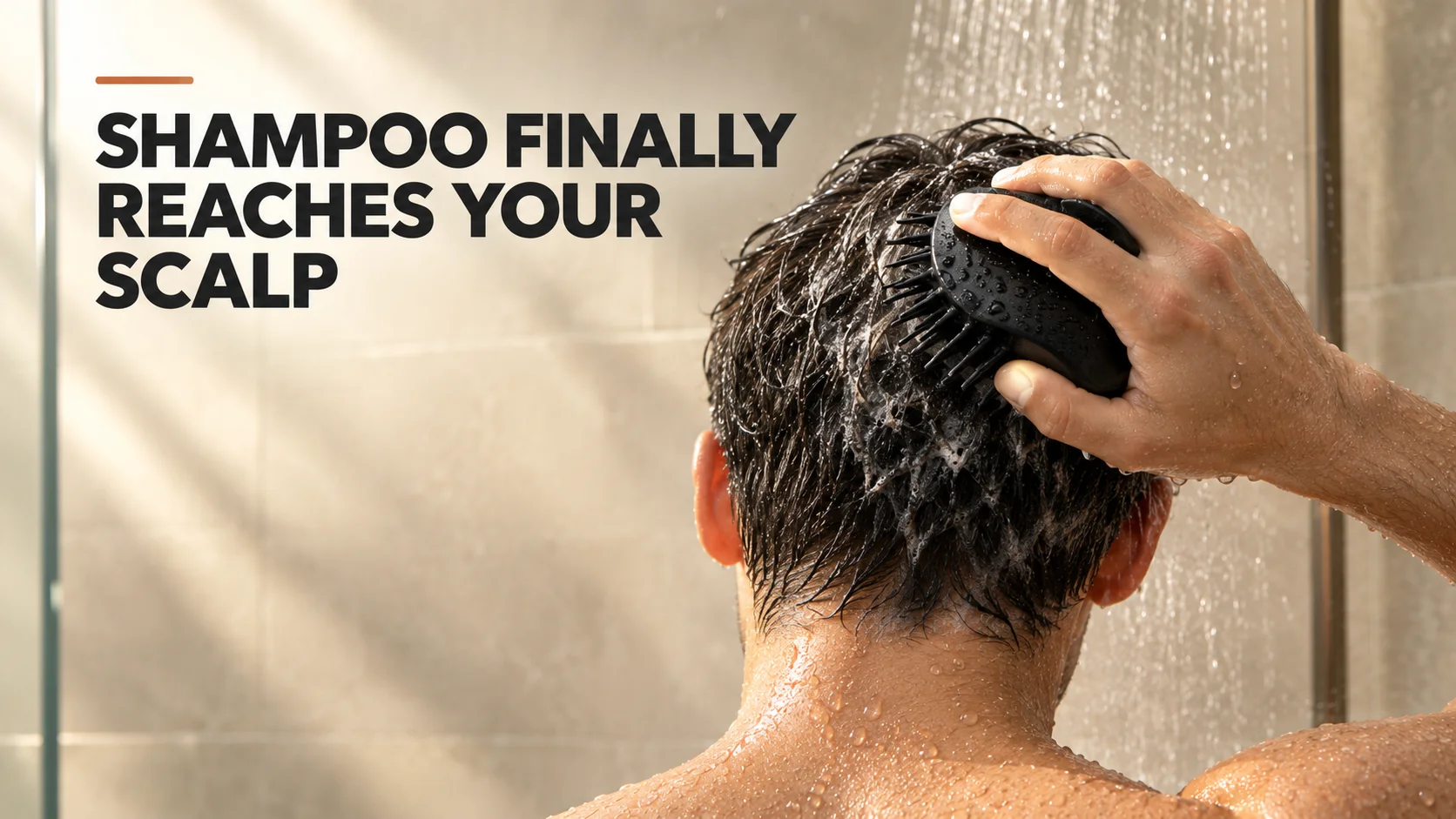
Tangle Teezer Scalp Exfoliator and Massager Review: The One to Pick When Silicone Scrubbers Slip

tangle teezer scalp exfoliator and massager review

1. The Hook

You step out of the shower, hair washed, and your scalp still feels coated. That coated feeling is why this tangle teezer scalp exfoliator and massager review starts in the shower, not on a shelf. You have rubbed shampoo in with your fingers. You have tried a soft scrubber that slipped away the moment your hands got soapy. You have wondered whether a proper scalp wash needs more effort than you have time for. It does not. It needs a tool that stays in your hand and reaches the skin under your hair.

tangle teezer scalp exfoliator and massager review

2. The Problem, Felt

You lather, you rinse, and the top of your hair looks clean while your scalp feels untouched. Shampoo sits on the surface because your fingers cannot part thick hair and reach the skin beneath it. You press harder, your fingers tire, and you give up halfway through the wash.

Then there is the scrubber that promised an easy fix. It slips when your hands get soapy. It pulls at tangles instead of gliding over them. It feels too soft to clear anything, or too rough to enjoy. You end up back where you started, with a scalp that feels coated and a shower that feels unfinished. What if the problem was never your effort, but the shape of the tool in your hand?

scalp brush slipping in a soapy shower

3. The Reveal

The tool at the center of this review is the Tangle Teezer Scalp Exfoliator and Massager, a palm-shaped brush made to cleanse, exfoliate, and massage the scalp in the shower. The listing states that it distributes shampoo evenly and suits all hair types. It has no handle. Instead, a winged shape fits into your palm, and you press to control the level of pressure.

Its teeth do two different jobs. Long, flexible teeth help remove product build-up and dead skin from the scalp. Short, thick teeth stimulate pressure points for a relaxing massage. You can use it on wet or dry hair, alone or with hair products. That split design is the detail that separates it from a single-texture scrubber, and it raises a fair question. Does a tool with two kinds of teeth actually wash better, or does it only sound clever?

Tap any photo in this article to see the current price, rating and reviews for yourself.

4. What Sets It Apart

Two lengths of teeth, two different jobs

Most scrubbers give you one texture and ask it to do everything. This brush splits the work. The listing states that the long, flexible teeth help clear product build-up and dead skin, while the short, thick teeth focus on pressure points and massage. In an ordinary wash, that means the first pass clears and the second pass soothes, without you switching tools or changing your grip.

A shape that stays in a soapy hand

A handle can twist in a wet hand. A flat pad can slide away. This brush uses a winged shape that sits in your palm, and the listing states that it is made to fit all hand sizes. You hold it the way you would hold a small stone, with your fingers curled around its wings, and you press to set the pressure. For a buyer whose last scrubber slipped at the worst moment, that shape is the first thing worth checking.

Shampoo that actually reaches the scalp

Think of shampoo on thick hair as rain on a thick canopy. It lands on top and never reaches the ground. The listing states that this brush distributes shampoo evenly. The teeth part the hair as you move the brush, so shampoo reaches the skin beneath instead of sitting on the surface. You rinse, and your scalp feels washed rather than merely wet.

Wet or dry, on your terms

You do not have to save this brush for shower days. The listing states that you can use it on wet or dry hair, alone or with shampoo. A dry pass before a wash can loosen build-up. A wet pass in the shower can spread shampoo. That flexibility matters for a buyer who wants one tool for a morning wash and a quick evening refresh.

dual length teeth of a scalp exfoliator brush

If that split-tooth design sounds like the missing step in your shower, see the scalp exfoliator and massager here.

5. What Buyers Are Saying in This tangle teezer scalp exfoliator and massager review

Buyers describe a brush that glides, reaches the scalp, and divides opinion on grip and stiffness.

Polina Gurina: “This brush glides smoothly and reaches directly to the scalp without any tugging.”

Lyons: “Make my scalp feel rejuvenated!”

Ki: “Durable enough that the bristles aren’t bending, but also not ergonomic in the hand.”

dekaizo kumasan: “I can hold the brush with both hands and brush my hair more carefully”

NYgirl: “Perfect for my fine but thick hair. Fits in my hands perfectly.”

Havanna: “This is the only product that doesn’t pull my hair out! This is my second purchase.”

Keith M: “Bristles are too ruff for me. I don’t use this too often.”

GLORIA E.: “It’s gentle yet, it does a great job on the scalp.”

Angie: “This does exactly what I need it to do.”

Jay: “I really love how this glides through my hair while massaging my scalp.”

scalp brush held in a palm during a shower routine

The pattern is clear. Most buyers praise the glide and the reach, while a smaller group warns about grip and bristle stiffness, so check those two points in the photos before you decide.

6. Is This Made for You?

This brush is built for people who wash their hair and still feel a coated scalp. It is built for people whose shampoo never quite reaches the skin, whose fingers tire during a wash, and whose last scrubber slipped or pulled. It is built for people who want a short, controlled scalp massage as part of an ordinary shower, on wet or dry hair.

Look at the photos closely and picture the grip in your own hand, because comfort there decides how often you will reach for it.

People Also Ask About tangle teezer scalp exfoliator and massager review

Do dermatologists recommend scalp massagers?

Dermatology guidance treats scalp massage as a relaxing scalp care step, not a treatment. The American Academy of Dermatology notes that finding the cause of hair loss comes first, since treatment depends on that cause. If your scalp is sore, inflamed, or shedding suddenly, talk with a doctor.

What are the disadvantages of a scalp massager?

Too much pressure can hurt, and use on an irritated scalp can make it feel worse. Some buyers find a palm grip slippery when hands are soapy, and some find the bristles stiff. A massager is a cleaning aid, not a replacement for care when a scalp problem needs attention.

Are scalp massagers good for your scalp?

Used gently, a scalp massager can help spread shampoo evenly and clear product build-up and dead skin from the scalp surface. It can also make a wash feel more complete. It does not treat a scalp condition, and it should never be pressed hard enough to hurt.

Do scalp massagers really work for hair growth?

The evidence is modest. A small 2016 study of nine men, using four minutes of scalp massage daily for 24 weeks, found thicker hairs but no significant gain in hair density. That means massage may support a scalp routine, but it does not promise new growth.

7. The Close: What This tangle teezer scalp exfoliator and massager review Leaves You With

You started with a scalp that felt coated after every wash and a scrubber that slipped when you needed it most. This tangle teezer scalp exfoliator and massager review leaves you with a simpler test. Does a palm-shaped brush, with long teeth for build-up and short teeth for massage, fit your hand and your shower? If it does, your wash may finally feel finished.

calm scalp care routine with a palm shaped brush

Tap the button below and check the price, rating and reviews with your own eyes.

See Price and Reviews

Affiliate links: I may earn a commission at no cost to you.

K18 Leave-In Molecular Repair Hair Mask Review: What 4 Minutes Can and Can’t Fix in Damaged Hair

K18 leave-in molecular repair hair mask review: white K18 pump bottle on honed stone steps

1. The Hook

This k18 leave-in molecular repair hair mask review starts with a straight answer. If your damage comes from bleach, color, chemical services, or heat, and you can follow the instructions exactly, the 4-minute trial is worth running. If split ends or shedding from the root are the problem, this mask is not the answer, and the honest next step is a trim or a clinician. That distinction is the whole review. Four minutes cannot fix everything, so what can it actually fix? The answer begins with the damage itself, and with why ordinary masks stop working by the next wash.

K18 leave-in molecular repair hair mask review: white K18 pump bottle on honed stone steps

2. The Problem, Felt

You know the pattern. You bleach or color, you add heat, and one morning the brush fills with short broken pieces. Your hair tangles at the nape, catches at the ends, and feels dry no matter how much conditioner you use. You buy a mask, and for one wash it feels soft again. Then the next wash takes it all away, because a coating only sits on top. It is like painting over a cracked wall: smooth for a day, unchanged underneath. You have tried the deep conditioners, the oils, the overnight masks, and each one promised a reset that faded by Tuesday. That cycle is why so many buyers stop believing any product can help. The frustration is not that nothing works. It is that nothing lasts. So what would a treatment have to do differently to last past the next wash?

Macro detail of K18 pump bottle beside a single fragile hair strand on dark graphite

3. The Reveal

The product is the K18 Leave-In Molecular Repair Hair Mask, a leave-in treatment built around K18PEPTIDE. The brand states that this biotech-developed peptide mimics hair structure and reconnects broken polypeptide chains and disulfide bonds damaged by bleach, color, chemical services, and heat. In plain words, the claim is repair inside the strand, not a coating on top of it. That is the difference the last section pointed to: a coating washes away, while a treatment working inside the strand is supposed to leave hair stronger after the product itself is gone. Whether that happens for you depends on the damage type, the routine around it, and consistent use. No single benefit carries the result alone. Each one matters, and the routine matters most. The next section shows what sets it apart, benefit by benefit.

Tap any photo in this article to see the current price, rating and reviews for yourself.

4. K18 Leave-In Molecular Repair Hair Mask Review: What Sets It Apart

Repair From Inside, Not On Top

The first benefit is the mechanism itself. The brand states that K18PEPTIDE reconnects broken polypeptide chains and disulfide bonds, which means the treatment aims inside the strand rather than smoothing over it. Think of a frayed rope: paint makes it look whole, while re-binding the fibers makes it hold. That is the idea here, stated as the brand’s claim, not as a promise to you.

A Ritual With a Timer

The second benefit is the ritual, and it is strict for a reason. Shampoo, do not condition, towel-dry thoroughly, apply 1 to 3 pumps from ends to roots, wait 4 minutes, and do not rinse. The brand explains that conditioner leaves a film that blocks the peptide from penetrating, which is why conditioner waits until after the 4 minutes. A timer keeps the ritual honest.

K18 bottle with folded towel and wide-tooth comb arranged for the wash routine

A Small Dose on Purpose

The third benefit is the dose. This is a concentrated formula, so 1 to 3 pumps based on length and density are the intended amount, not a short pour. A small dose used exactly beats a large dose used carelessly, because the peptide needs a clean, damp strand and the full 4 minutes to work.

A Trial Window, Then Maintenance

The fourth benefit is the window. The brand directs first-time use for 4 to 6 washes post-salon service, then as needed for maintenance, and states that most see results after 2 to 3 uses, varying with hair type and level of damage. That window turns hope into a test: run it exactly, watch tangling, texture, and breakage, and then decide.

If the trial window sounds fair, see the K18 mask here and judge the routine for yourself.

5. What Buyers Are Saying

Ten buyers, quoted exactly as written, including two who were not impressed.

D. Terry: “It takes very little product to do wonders. It’s very easy to use.”

Alla H: “The tangles at the nape of my neck are gone. My hair has a healthy shine without looking oily.”

Tina: “This is a game changer for my hair. It’s enhancing the waves to almost curly.”

GG: “The next morning, I used my straightener on medium heat and was stunned. Instead of the usual dry straw, my hair was sleek, shiny, and bouncy.”

LJohnson: “The repair leave-in mask worked as a detangler and much more. Very nourishing. Helps to defrizz in humid air too.”

amy babcock: “I’ve noticed a significant improvement in how healthy, soft, and manageable my hair feels.”

Bebe: “It didn’t do much for the dryness but it did coat my hair and weigh it down.”

Trailing Spouse: “K18 is an excellent product, and I do notice a difference in the texture and condition of my fine, frizzy hair.”

Michelle: “The difference in my hair is shocking. I keep touching the ends of my hair because they feel soft… like my old hair.”

Kayla L: “I have noticed a huge difference in my hair texture as well as how it’s not tangling anymore and it just feels healthier and looks better.”

Top-down view of K18 bottle on bone-white stone with soft fabric and hair swatch

Every photo here opens the product page, where you can check the current price, rating and remaining reviews.

6. Is This Made for You?

This mask is built for people whose damage has a clear cause: bleach, color, chemical services, or repeated heat styling that left hair weak, tangled, or breaking. It is built for people who already tried ordinary masks and watched the smoothness wash away by the next wash, and who can follow a strict ritual without improvising. If you have not tested your hair yet, start with protein vs moisture hair how to tell and run the strand test first, so the treatment matches the problem. If shedding from the root is the problem, or split ends keep splitting upward, the honest next step is a clinician or a trim, not a mask.

Tap a photo when you are ready to see the current price, rating and reviews with your own eyes.

How do you use the K18 Leave-In Molecular Repair Hair Mask?

Shampoo and do not condition, towel-dry thoroughly, apply 1 to 3 pumps from ends to roots, let it sit for 4 minutes, and do not rinse it out. Then comb, add other products if wanted, and style as usual.

Do you really skip conditioner with K18?

Yes, before the mask. The brand explains that conditioner leaves a film that blocks the peptide from penetrating effectively. After the 4-minute wait, conditioner or other products may be used.

How long does it take to see results?

The brand states most see results after 2 to 3 uses, varying with hair type and level of damage, and directs first-time use for 4 to 6 washes before switching to maintenance use as needed.

Can the K18 mask repair split ends?

Not permanently. A mask can smooth a split end for a day, but it cannot glue it back together for good. If a split end keeps catching and splitting farther up, a trim is the honest fix.

7. K18 Leave-In Molecular Repair Hair Mask Review: The Close

This k18 leave-in molecular repair hair mask review comes down to a fair test, not a leap of faith. Run the 4-minute ritual exactly for 4 to 6 washes, watch tangling, texture, and breakage, and let the result decide. If the trial passes, maintenance follows. If it does not, the product was tried properly and simply is not the answer for that hair. For the diagnosis that comes before any repair step, read the protein vs moisture strand test guide and run the test first.

K18 bottle on a calm bathroom vanity shelf in warm late-afternoon light

Tap the button below and check the price, rating and reviews with your own eyes.

See Price and Reviews

Affiliate links: I may earn a commission at no cost to you.

Protein vs Moisture Hair How to Tell What Your Hair Needs:

Protein vs moisture hair how to tell: hands stretching a wet strand to test stretchy or snapping hair

Last updated: October 27, 2026

Quick Answer: Protein vs moisture hair how to tell? Take one clean, wet, shed strand and pull it gently from both ends. If it stretches a little and springs back, it is balanced. If it stretches a long way, feels gummy or mushy, and does not spring back, it is leaning protein-weak. If it barely stretches and snaps quickly, it is leaning moisture-dry. Test two or three strands from different areas, because ends are older and more damaged than roots, then change one thing at a time and retest.

Protein vs moisture hair how to tell: hands stretching a wet strand to test stretchy or snapping hair

Key Takeaways

  • The wet strand stretch test is the fastest home diagnostic: one shed strand, a gentle pull, and three possible readings.
  • Opposite problems look alike. Protein overload feels dry and stiff, while moisture overload feels limp and weak.
  • Never stack fixes. Reset to a simple baseline for two to three washes, change one thing at a time, then retest.
  • A mask can make a split end look smoother for a day, but it cannot glue it back together. A trim is the honest fix.
  • Breakage is not the same as shedding from the root. Sudden or severe change needs a clinician, not a new product.

What Protein and Moisture Actually Do for a Strand

Hair is mostly a protein fiber, and moisture is what keeps that fiber flexible instead of brittle. Protein gives the strand its structure and strength, and moisture gives it the ability to bend without snapping. When the two are in balance, hair stretches a little under pull and returns to its length. When either side runs short, the complaints look frustratingly similar: dryness, tangling, breakage, and styles that will not hold.

One honest limit matters first. The visible strand is dead fiber. Care can protect it, smooth it, and cut down friction, but it does not heal like skin. The goal here is not to rebuild hair from scratch, but to read what the strand is asking for, so the next step helps instead of adding to the problem.

Protein vs Moisture Hair How to Tell: The Simple Strand Test

The test takes less than a minute and needs nothing you do not already have. Use a shed strand, not one pulled from the scalp, because pulling can damage the root and tells you nothing extra.

Hands holding a wet hair strand over a white dish for the simple strand test
  1. Find one clean, shed strand, ideally after a wash, with no heavy styling product on it.
  2. Wet the strand fully. The test reads the strand in its wet state, because wet hair shows elasticity that dry hair hides.
  3. Hold one end in each hand and pull gently from both ends. The word gently matters. Yank a healthy strand hard enough and it will break too, which proves nothing.
  4. Watch two things: how far it stretches, and whether it springs back when you let go.
  5. Repeat with two or three strands from different areas. Ends are older and more damaged than roots, so one area can read differently from another. That is information, not contradiction. It often means the ends need one thing while the mid-lengths are fine.

The three readings are straightforward:

  • Balanced: the strand stretches somewhat, resists a little, and returns to roughly its original length when released.
  • Protein-weak: the strand stretches noticeably, feels elastic like a rubber band or gummy and mushy when wet, and either does not return or returns only partly.
  • Moisture-dry: the strand barely stretches at all, snaps quickly and cleanly under minimal pull, and feels rough, straw-like, or brittle.

Guides disagree on an exact stretch percentage, so this article stays qualitative on purpose. A little stretch with a spring back, a long stretch with no spring back, or almost no stretch with a quick snap is all you need.

Reading the Signals: Protein-Weak, Moisture-Dry, or Balanced

The test is the anchor, but daily signs add useful context when a single strand reading feels unclear.

Protein-weak signs beyond the test include limp, stringy hair that will not hold a style, curls that lose definition and hang loose, and a mushy or gummy feel when wet.

Moisture-dry signs beyond the test include a dry, rough feel, constant tangling, rigidity, ends that feel dry within hours of styling, and split ends that keep catching.

Balanced hair is less dramatic, which is the point. It stretches a little and springs back, holds a style reasonably well, and does not feel mushy when wet or straw-like when dry. If that is the reading, keep the routine steady rather than adding a new treatment in search of a problem.

The Overcorrection Trap: When the Fix Becomes the Problem

This is where most hair routines go wrong, and it is the reason a test matters more than a guess. Each problem, treated with the wrong fix, starts to look exactly like the other problem, which invites more of the wrong fix.

Hands holding a hair strand showing limp and snapped ends from the overcorrection trap

In the protein direction, the trap runs like this. Hair feels dry, so a protein treatment is added. Hair gets stiffer and drier, which reads as needing more repair, so another protein treatment follows, and hair starts snapping. This is protein overload, and it looks almost exactly like severe dryness: dry, brittle, stiff, and straw-like, with curls that feel rough or tangled and do not clump well.

In the moisture direction, the trap runs in reverse. Hair feels stiff, so more conditioner is loaded on. Hair goes limp and mushy and loses definition, which reads as needing more conditioning, so more deep conditioner follows. This is moisture overload, sometimes called hygral fatigue, and it looks a lot like fine, weak hair: too soft and stretchy, lacking definition and strength.

One nuance deserves honesty. One trichologist view is that protein inside the hair is very hard to replace with products, because product protein mostly forms a film over strands rather than getting right inside. Another view is that continuous overuse of protein products can still leave hair dry, lifeless, and hard to manage. The mechanism is not settled, but in practice, piling on more of either side without retesting is how the trap closes.

Protein vs Moisture Hair How to Tell After a Baseline Reset

If overcorrection is suspected, the fix sequence starts with subtraction, not addition. Simplify to a cleanser and one basic conditioner for two to three wash cycles, let hair return to a readable baseline, then reintroduce one variable at a time and retest after each change.

Unbranded cleanser and conditioner bottles beside a folded towel for a baseline reset routine

The sequence looks like this:

  1. Baseline reset: cleanser plus one basic conditioner, nothing else, for two to three washes.
  2. Retest with the strand test, noting which areas read differently.
  3. Change one thing only. If the reading points protein-weak, add one protein-side step. If it points moisture-dry, add one moisture-side step.
  4. Give it at least a full wash cycle, then retest before changing anything else.

One change at a time is the whole discipline. Two new products at once make it impossible to know which one helped or hurt.

Two honest notes belong here. First, split ends: a mask can make a split end look smoother for a day, but it cannot glue it back together for good, and a trim is the honest fix if it keeps catching and splitting farther up. Second, if the test points toward damage that needs a targeted repair step, see what one such option actually claims before buying. For a closer look at one leave-in repair option, see our review of the K18 Leave-In Molecular Repair Hair Mask.

What Shifts the Balance in Either Direction

Balance does not drift on its own. Routine habits push it one way or the other.

What shifts the balance toward needing more protein-side support includes color, bleach, relaxers, keratin treatments, frequent high-heat styling, tight styles and heavy manipulation, and sun and chlorine over a season. These wear down strand structure, which is why chemically treated or heat-styled hair so often reads protein-weak.

What shifts the balance toward needing more moisture-side care includes repeated protein treatments, clarifying frequently, dry indoor air and low humidity, and protein-heavy products used daily without a balancing conditioner. A routine that is all strength and no softness will eventually read dry, even though the cause is too much protein-side input.

If a routine includes oiling, note that scalp reactions have their own timeline and signs, which we covered separately in how long rosemary oil takes to work. A scalp that itches after oiling is not the same problem as a strand that snaps.

When to Stop Troubleshooting: Breakage, Shedding, and the Safety Box

Home testing has a boundary. Breakage and shedding are different problems. Protein-side weakness in the shaft causes breakage, which shows up as short broken pieces and thinner ends. Shedding means hair falling from the root, often with the bulb attached.

Safety Box

Stop troubleshooting at home and talk with a doctor or trichologist if any of these apply: shedding from the root in noticeable amounts, sudden or severe change, bald patches, or an inflamed, painful, or broken scalp. A product cannot fix a problem that starts under the skin, and no strand test diagnoses a medical condition.

One more careful distinction: experts quoted in Bustle note that true dietary protein deficiency affecting hair is rare, and that a product cannot infuse protein into a strand to fix a dietary cause. Shaft care means cutting friction and protecting the strand, and this article does not claim a diet change fixes shaft breakage.

People Also Ask

What is the strand test for hair?

It is a simple home diagnostic. Take one clean, wet, shed strand, pull it gently from both ends, and watch how far it stretches and whether it springs back. A little stretch with a spring back means balanced. A long, gummy stretch with no spring back points protein-weak. Almost no stretch with a quick snap points moisture-dry.

Can hair need both protein and moisture?

Yes, and different areas often need different things at the same time. Ends are older and more damaged than roots, so ends can read protein-weak while mid-lengths read balanced. That is why the test uses two or three strands from different areas, and why one change at a time matters more than one product for the whole head.

How often should I use a protein treatment?

There is no single schedule that fits every head of hair, because damage level, routine, and the test reading all shift the answer. The safer rule is test-led: use a protein-side step only when the strand test points protein-weak, then retest before repeating it. Repeated use without retesting is how protein overload builds.

Does protein overload make hair dry?

Yes, and that is the trap. Protein overload feels dry, brittle, stiff, and straw-like, which looks almost exactly like severe dryness. Adding more protein to overloaded hair makes it stiffer and more likely to snap, which is why a baseline reset and a retest come before any new treatment.

Can split ends be repaired?

Not permanently. A mask can smooth a split end for a day, but it cannot glue it back together for good. If a split end keeps catching and splitting farther up the strand, a trim is the honest fix, and it protects the rest of the length from further splitting.

Protein vs Moisture Hair How to Tell: The Bottom Line

Protein vs moisture hair how to tell comes down to one gentle pull on a wet, shed strand, read honestly, and then one change at a time. A little stretch with a spring back means balanced. A long, gummy stretch with no spring back means the protein side needs attention. Almost no stretch with a quick snap means the moisture side needs attention. The discipline around the test is what makes it work: reset to a baseline when overcorrection is suspected, change one thing, retest, and stop troubleshooting at home when shedding, sudden change, or scalp problems point to a clinician instead.

If the test points toward damage that needs a targeted repair step, read the full review before deciding: K18 Leave-In Molecular Repair Hair Mask Review.

Sources: Who What Wear, quoting stylists Hallock and Reavey; MyRevair; Acure straw test explainer; Power Your Curls; Refinery29, quoting trichologist Hannah Gaboardi and other quoted experts; Bustle, quoting quoted experts; HeyCurls; Hairsloom guide; Hair Affairs guide.

This article is for general information only and is not medical advice.

Leave-In Cream for Frizzy Hair: Why Smooth Hair Fades by Lunch

Leave-In Cream for Frizzy Hair: Why Smooth Hair Fades by...

The 8 a.m. Mirror vs. the Midday Mirror

Your hair looked sleek at 8 a.m. By lunch, the air outside had other plans.

Frizz rarely announces itself. It arrives one flyaway at a time, usually when you least expect it.

You styled it with care, and still the fuzz found its way back. A leave-in cream for frizzy hair is meant to narrow that gap between the morning mirror and the midday one.

But what is your hair actually doing between those two moments? The answer is simpler than you might think.

Leave-in cream for frizzy hair: Olaplex N°.6 Bond Smoother resting on a pale stone ledge in soft window light

Why Humidity Turns a Good Hair Day Frizzy

You know the moment. You step outside, the air feels heavy, and the smooth line you built at the mirror starts to lift and curl at the edges.

Maybe it happens on the walk from the car, or the moment a crowded room warms up. Either way, the style you worked on fades while you watch.

You checked the mirror twice before leaving, and it looked right. Then the day happened.

Here is the science in plain words. A chemist writing in Scientific American explains that high humidity, or a damaged outer layer, lets more water into a hair.

Too much water can swell that layer and leave hair looking frizzy. Picture a dry sponge beside a puddle. Dry hair behaves a little like that sponge, soaking up whatever moisture is nearby.

That is why frizz can show up on a damp afternoon, even after a smooth blow dry. It is also why flyaways seem to appear from nowhere.

So what could a leave-in cream actually do about it? One option deserves a closer look.

Olaplex N°.6 Bond Smoother anti-frizz styling cream near a damp window, set for a humid day

A Leave-In Cream for Frizzy Hair Worth a Closer Look

Meet Olaplex N°.6 Bond Smoother, a leave-in anti-frizz styling cream. It is aimed at one everyday frustration: hair that starts smooth and does not stay that way.

The listing describes it as a velvety, hydrating cream made for smoother, softer blow-dries and more defined air-dried styles, all without weighing hair down.

The product page suggests applying it to clean, damp hair, then combing through and styling as you like. The brand adds that a light touch on already styled hair can help tame flyaways.

The concern at the center is plain: frizz, and the flyaways that come with it. It leans on three promises: frizz control with humidity resistance, soft and hydrated hair, and easier detangling.

Want a quick look at the current price, rating and reviews first? Tap any photo in this article to see them for yourself.

What Sets This Leave-In Cream for Frizzy Hair Apart

Picture the elevator ride before a big meeting. You glance at the mirrored wall, and your hair still looks the way you styled it. Four details on the product page point toward that picture.

The 72-hour claim, explained

The brand states that it reduces frizz and flyaways for up to 72 hours, and the listing pairs frizz control with humidity resistance. If you are searching for how to control frizz in humidity, that pairing is the part to read closely.

How smooth can feel light

The listing says smoothness comes without weighing hair down, and the brand says it adds no hold or excess weight. Reviewers describe a soft, light feel. Several reviewers say a small amount goes a long way.

Olaplex N°.6 Bond Smoother leave-in cream shown up close beside a smooth swirl of the cream

Why detangling belongs on the list

The listing’s manufacturer section states 91% easier detangling. In daily life, that is the comb gliding through instead of catching, which matters when you are short on time.

What the page says about heat

If you use a blow dryer or flat iron, the listing states 450°F/232°C heat protection, a detail to note if you are weighing a heat protectant for hair. If you prefer to air-dry, it also says the cream controls frizz and helps define air-dried styles.

To see how all four details sit together on the product page, open the full listing and check the current price, rating and reviews.

What Buyers Are Saying About This Anti-Frizz Cream

Brand lines only go so far. Here is how buyers describe it in their own words.

Adriel Morfa: “It helps control frizz, smooths flyaways, and leaves my hair much softer without making it feel heavy or greasy.”

Gina: “It helps to tame my hair as well as fill the hair shaft and protect it from humidity.”

Melissa Lower: “Doesn’t leave any sticky or crunchy residue once it’s worked through.”

nick: “Feels very light in your hair, and is not greasy or heavy.”

Marie: “It leaves my hair nice, soft, and tangle free and it’s non greasy.”

JM: “This product goes on quickly after showering and turns my knotted mess into silky locks.”

Karen E.: “I love this stuff ive been using it for about 3 years and it never let’s me down.”

Wayne: “it protects my hair and keeps it soft even when I use heat daily- and it smells good.”

GK Cantrell: “Love this! It made my hair so soft, conditioned & no frizz.”

Menna selim: “I love it but just make sure to put little by little otherwise ur hair gonna get greasy”

Olaplex N°.6 Bond Smoother leave-in styling cream beside a folded towel, ready for a morning hair routine

Only a few voices fit here. The photos above open the product page, where the current rating and the rest of the reviews are waiting.

Is This Leave-In Cream Made for You?

It is built for people who want smoother, softer hair and a calmer finish on humid days. If you air-dry, blow-dry, or switch between both, the listing says it was made with both routines in mind.

It is also built for people who dislike heavy products. The brand says it adds no hold or excess weight, and several buyers mention a light feel.

And it is built for people with tangles to manage, since the listing states easier detangling.

If your hair frizzes whenever the air turns damp, this is the profile the listing speaks to. It also suits anyone who likes a simple routine: apply, comb through, style, go.

Wondering how it all adds up for your hair? The current price, rating and reviews are one photo tap away.

People Also Ask About Leave-In Cream for Frizzy Hair

What causes frizzy hair?

Healthline reports that frizz often starts with dryness. A dry outer layer turns rough and takes in moisture from humid air, and harsh products or chemical treatments can strip natural oils and add to the problem.

Does heat styling make frizz worse?

The American Academy of Dermatology says styling habits can leave hair brittle and frizzy, and that excessive heat can damage any hair type. Its advice: limit blow drying and hot tools, use low or medium heat, and add a product that protects hair from heat.

How do you get rid of frizzy hair?

Medical News Today suggests hydrating conditioners, gentler brushing, less heat styling and a small amount of lightweight cream to smooth frizz. It adds that frizz cannot always be fully prevented. If better care does not help, the American Academy of Dermatology suggests seeing a dermatologist.

Where should you apply a leave-in cream?

The brand’s directions for this cream say to work a small amount into damp hair, from the mid-lengths to the ends, then comb through and style as you like. Buyers often say a little goes a long way.

Back to That Midday Mirror

Remember the 8 a.m. mirror and the midday one? The gap between them is where a leave-in cream for frizzy hair earns its keep.

Smooth hair at 8 a.m. is easy. Smooth hair at lunch is the real question.

Olaplex N°.6 Bond Smoother is described as a cream that controls frizz, helps define air-dried styles, softens and hydrates, with heat protection listed too.

The one thing this article cannot show you is how it all looks today: the current price, rating and newest reviews.

Olaplex N°.6 Bond Smoother anti-frizz cream in warm late-afternoon light, a calm close to the day

Tap the button below and check the current price, rating and reviews with your own eyes. It takes one tap, and the judgment is yours.

See Price and Reviews

Affiliate links: I may earn a commission at no cost to you.